
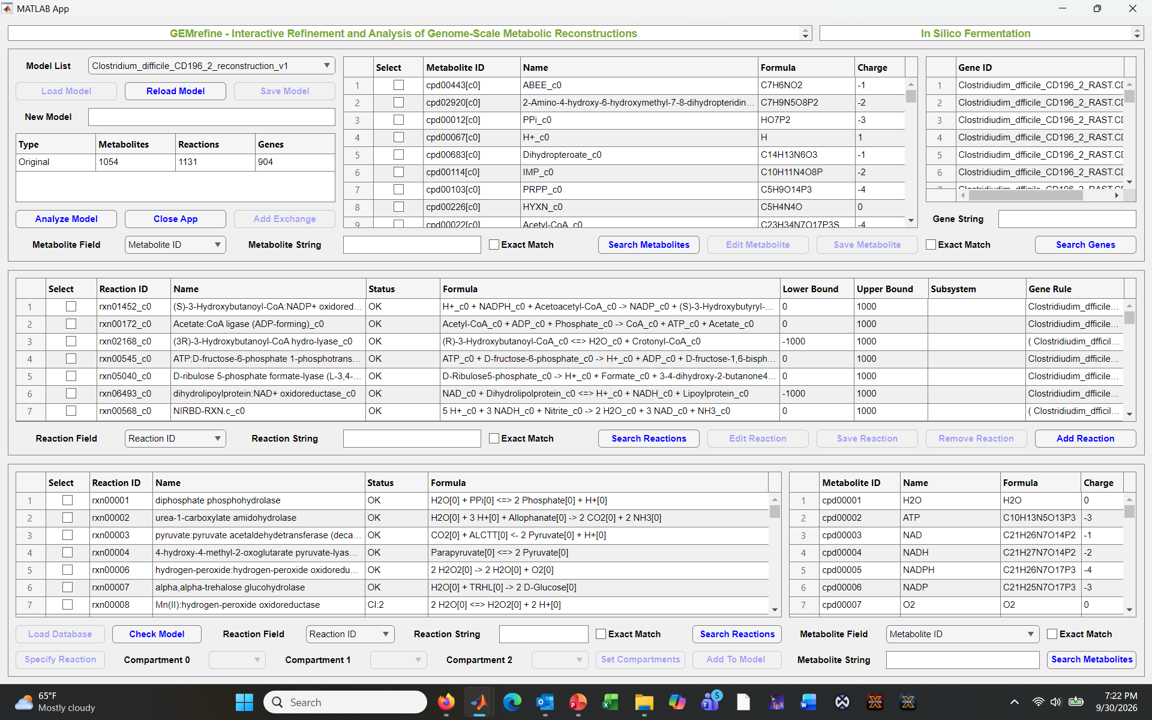
Snapshot of GEMrefine showing the metabolites, genes and reactions of a metabolic reconstruction (top two panels) along with reactions and metabolites obtained from the ModelSEED biochemistry database (bottom panel).
GEMrefine was released by In Silico Fermentation in October 2026. Please continue reading this page to learn more about the application and to download this free software.
A draft genome-scale metabolic reconstruction generated from an annotated genome using computational pipelines such as the DOE ModelSEED and Kbase platforms invariably contains incomplete metabolic pathways due to missing reactions. While many of these reaction gaps have no effect on functional capabilities, incomplete pathways associated with important functions need to be identified, completed and tested through a process known as manual refinement or curation. Draft reconstructions typically undergo multiple rounds of manual refinement to generate a high-fidelity model with accurate descriptions of the key metabolic functions. The COBRA toolbox provides numerous functions to facilitate the refinement process, but the user must write MATLAB or python code to use the available functions and establish a suitable workflow.
GEMefine is a MATLAB application that enables manual refinement and analysis of draft metabolic reconstructions within a GUI environment. The main app allows the tabularization and search of all model, reactions and genes along with their relevant properties. Existing reactions and metabolites can be edited, while new metabolites and genes can be automatically added through the manual addition of new reactions. For draft models generated with the ModelSEED and Kbase platforms or other pipelines such as gapseq that utilize ModelSEED nomenclature, new reactions and metabolites can be added directly from tabularized versions of the ModelSEED biochemistry database. The companion app allows detailed structural analysis of the refined reconstruction. To identify pathway gaps, the user can display all blocked reactions and all dead-end and blocked metabolites. Pathway completion can be checked by calculating the maximal flux between any two metabolites. Nutrient uptake bounds can be modified before performing FBA/FVA to calculate and plot the growth rate, nutrient uptake fluxes, and product secretion fluxes. The modified model can be saved at any pint during the refinement process.
!!!The following PDF file provides an overview of how BacMicroSim can be used to develop and simulate community metabolic models for predictingdifferential production of short chain fatty acids in the gut microbiomes of gouty arthritis and healthy patients. The predictions are consistent with the hypothesis that production of the anti-inflammatory metabolite butyrate is reduced in the microbiomes of patients suffering from gouty arthritis.
