
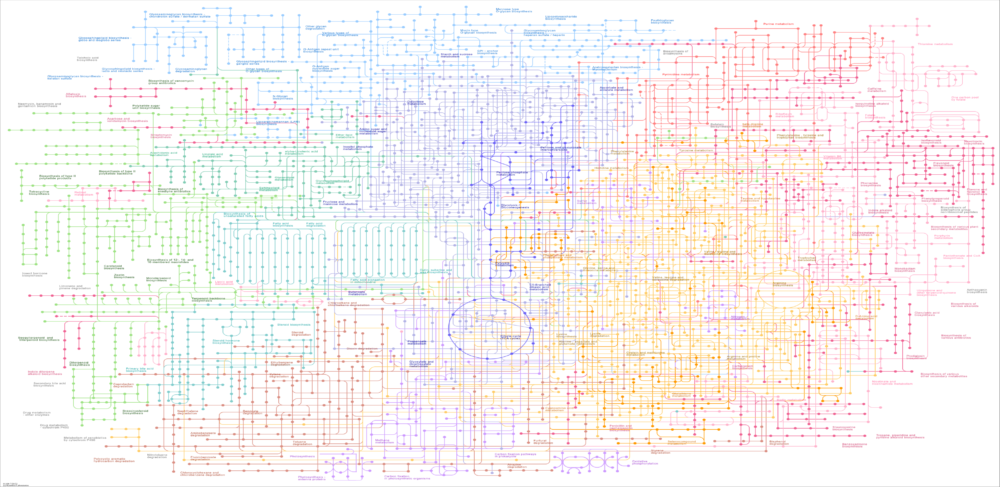
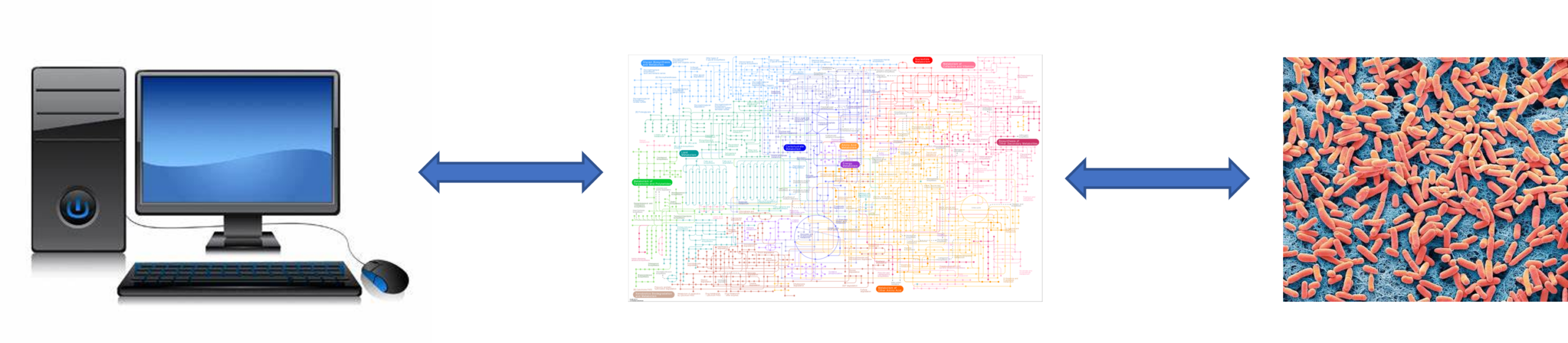
Metabolic engineering involves the modification of cellular metabolism to enhance the production of native metabolites or to enable the synthesis of new products. Traditionally, metabolically engineered strains have been developed using the design-build-test-learn cycle popularized in the closely related field of synthetic biology. In silico metabolic engineering aims to accelerate the strain design process by using genome-scale metabolic reconstructions to predict genetic manipulations that achieve the metabolite production objective. In Silico Fermentation can use computational tools to identify both promising metabolic engineering designs to be prioritized experimentally and poor designs to be eliminated from further consideration.
Gene Knockout Mutant Design
The primary genetic manipulations identifiable from a metabolic reconstruction are gene knockouts, which can be implemented in silico by using the modeled gene-protein-reactions (GPR) associations to predict how proposed gene knockouts effect the associated reactions. If a knocked out gene is necessary to enzymatically catalyze a particular reaction, the reaction is blocked such that its flux remains zero. We have experience implementing experimentally proposed gene knockout strategies to predict their performance and using COBRA computational methods such as OptKnock for de novo design of metabolite producing strains. Our MATLAB app inSilicoKO implements an expanded OptKnock workflow that allows the user to guide the strain design procedure towards an experimentally implementable solution.
Gene Expression Mutant Design
The in silico identification of gene overexpression and underexpression targets is more challenging because metabolic reconstructions do not explicitly model gene expression levels or enzyme concentrations. The COBRA method OptForce generates combinations of gene expressions changes (i.e., knockouts, upregulations, and/or downregulations) predicted to maximize production of a target metabolite. We have experience using OptForce to predict genetic manipulations in both wild-type strains and mutant strains with heterologous pathways inserted to enable non-native metabolite synthesis. Regardless of the design method used, we interrogate metabolite production strain models with both flux balance analysis and flux variability analysis, as gene knockout strain models are notorious for generating alternative flux solutions.
Please contact us to discuss your metabolic engineering problem and our in silico strain design capabilities.
