
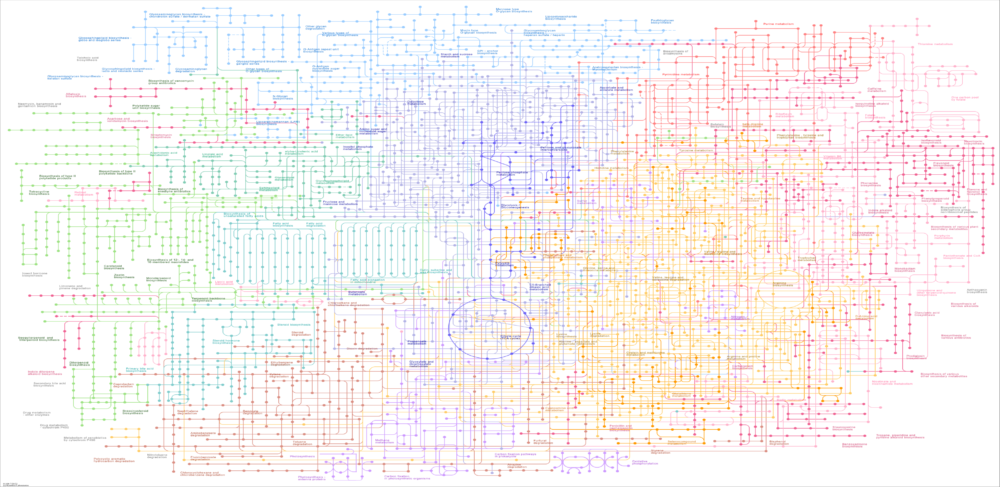

While software tools such as the Constraint-Based Reconstruction and Analysis (COBRA) toolbox facilitate the utilization of genome-scale metabolic modeling methods, users typically must adapt tool capabilities to develop their own customized workflows. Such efforts require a functional understanding of and hands-on experience with genome-scale metabolic reconstructions and associated constraint-based modeling methods. Some background on the essential mathematical methods, most notably linear programming, is also important to understand the impact of model formulation on the resulting computational results. Outside of specialized academic courses, the training necessary to effectively utilize these methods is largely unavailable to non-expert graduate/post-doctoral students and industrial practitioners.
To address this challenge, In Silico Fermentation is offering a training course focused on genome-scale metabolic reconstructions and their use for constraint-based metabolic analysis. The training focuses on developing a functional knowledge of metabolic reconstructions and more in-depth understanding of flux balance analysis (FBA) and its most important variants. Key concepts are demonstrated through computational exercises using metabolic reconstructions of the bacterium Escherichia coli. Each topic includes an interactive exercise where participants implement the presented method on a metabolic model of their choice with assistance from the instructor as necessary. Participants complete the training with customized MATLAB codes and the hand-on experience necessary to implement metabolic modeling in their own workflows.
The training is specifically designed for on-line delivery in time blocks defined by the participants to maximize work flexibility and information retention. The full course with interactive exercises can be covered in 24 on-line hours, while abbreviated versions presented with more traditional lectures can be completed in as little as 8 on-line hours. The course can be offered to 6-12 individual registrants or directly to employees from a single organization to allow a more customized training experience.
Main Topics
1. Understanding genome-scale metabolic reconstructions
2. Performing flux balance analysis using metabolic reconstructions
3. Applying flux variability analysis for characterizing non-unique flux solutions
4. Developing in silico media to achieve model growth
5. Using the MATLAB Constraint-Based Reconstruction and Analysis (COBRA) toolbox
6. Utilizing the MediumFBA app for integrated medium design and flux balance analysis
Course participants are expected to have some limited practical experience with the following topics:
1. Microbial metabolism
2. Linear algebra
3. MATLAB or comparable high-level programming language
Please contact us by email if you would like to receive additional details about this training course, including cost and scheduling information.
