
Microbial communities are ubiquitous in engineering applications and throughout nature. Synthetic consortia are small communities comprised of defined strains that have been assembled in the laboratory. Most commonly, synthetic consortia are developed to perform a particular bioconversion task that cannot be achieved easily with a single strain. By contrast, natural communities are large, poorly defined collections of microbes that have synergistically adapted to a particular environment. Of particular interest are host-associated communities such as the gut microbiota that have been shown to effect human health and disease. In Silico Fermentation offers cutting-edge expertise in developing microbial community models in which each strain is described by a genome-scale metabolic reconstruction to allow computational interrogation of synthetic and natural communities.
Synthetic Microbial Communities
The prototypical metabolic engineering problem is to engineer a microbial strain that is capable of converting a particular substrate to a specific product at high yield and titer. Due to the high metabolic burden placed on the engineered cell as non-native functionalities are introduced, the development of synthetic communities in which specialized bacterial strains collectively possess the desired substrate utilization and product synthesis capabilities is a practical alternative. We offer expertise in constructing community metabolic models for analysis of synthetic consortia with respect to their performance and robustness. Our SynComSim app implements the SteadyCom algorithm and provides a complete workflow that allows community models to be formulated and simulated for rapid assessment of proposed synthetic consortia designs.
Human-Associated Microbial Communities
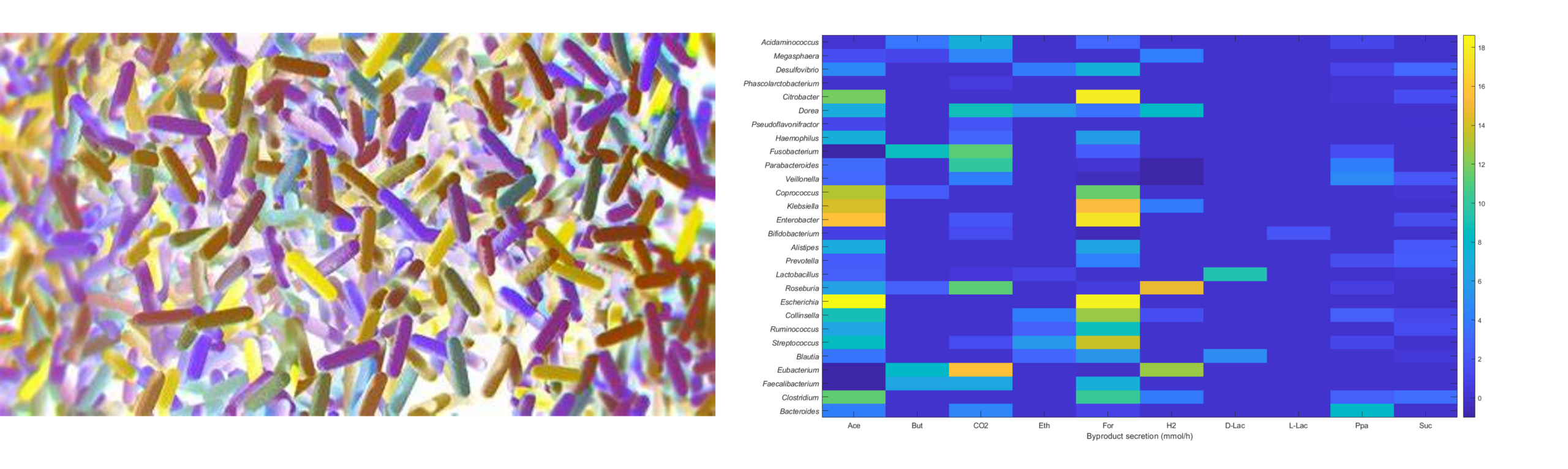
The relative abundances of bacterial taxa contained in host-associated community samples can be determined using 16S rRNA gene and metagenomic sequencing. These taxa abundance data can be used to build and constrain community metabolic models to investigate interactions between taxa and the collective nutrient consumption and metabolite synthesis capabilities of the community. We have considerable experience mapping taxa abundances into metabolic reconstructions developed for the appropriate taxonomic levels and the use of these taxa metabolic models for community simulations. Our BacMicroSim app provides an integrated workflow that automates selection of taxa metabolic models derived from the Virtual Metabolic Human database and performs community simulations using the COBRA metagenomics pipeline to explore the metabolic signatures of health- and disease-associated communities.
Please contact us to discuss your microbial community applications and learn more about our modeling capabilities.
